I bet you didn’t know before there were phones or Wi-Fi, there were roots — deep, tangled, and quietly alive. Scientists have discovered that trees don’t just stand side by side; they communicate through a vast underground network of fungi and chemical signals. This secret language of the forest is ancient, emotional, and surprisingly social.
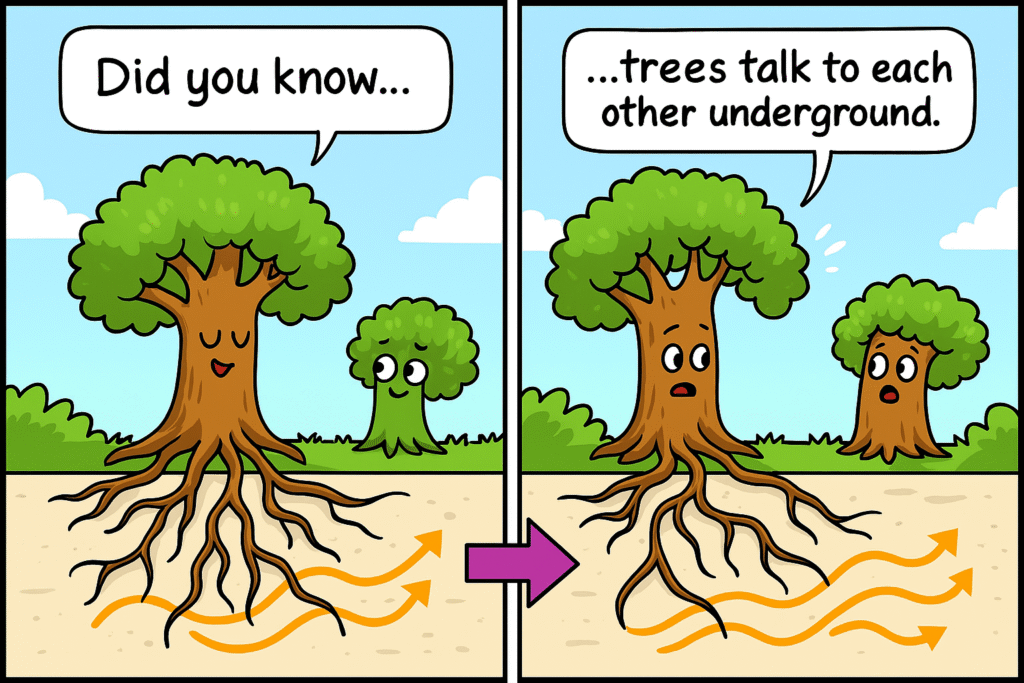
Did you know that forests are full of conversations? 🌳💬
Not the kind you can hear, but ones whispered beneath your feet — in the soil, through roots, fungi, and molecules.
For centuries, humans thought trees were silent, solitary beings. But science now shows they’re part of a massive, living network — a real-life internet of nature known as the Wood Wide Web.
This underground communication system connects trees in ways so intricate it makes our Wi-Fi look clumsy. They share nutrients, warn each other about pests, and even send comfort to their “family.” In other words, trees don’t just grow together — they talk together.
🌿 The Hidden Internet Beneath the Forest Floor
Let’s start with the basics: under every forest lies a web made of mycorrhizal fungi — tiny, thread-like structures that connect tree roots. These fungi trade nutrients and messages like ancient data cables.
Think of them as nature’s broadband — delicate but powerful, organic but efficient.
When a tree needs water or nitrogen, the fungi help deliver it. When a pest attacks one tree, the fungi carry chemical signals warning others to prepare.
It’s teamwork at a cellular level.
Forests aren’t just groups of trees — they’re communities with group chats. 😂🌳
🍄 The Fungal Network That Makes It All Possible
The real heroes of this system are fungi — specifically, mycorrhizae, which means “fungus-root.”
They form symbiotic relationships with plants: the fungus provides minerals, while the plant feeds it sugar made from sunlight.
Under a microscope, these fungal threads look like glowing white filaments stretching for miles underground. They connect not just individual trees but entire species. A birch in one corner of the forest might send carbon to a pine tree hundreds of feet away — through fungal channels invisible to the human eye.
This exchange is so efficient that some scientists joke the forest operates like a biological stock market, with trees trading resources based on need and season. 🌲💱
🌳 Mother Trees: The Forest’s Central Servers
In every forest, there are elders — massive old trees that anchor the network. Scientists call them mother trees. They feed saplings, transfer extra nutrients, and even recognize their offspring through root chemistry.
When a mother tree senses her “children” struggling in the shade, she sends them sugars through the underground network to help them survive. 🍼🌿
When she’s dying, she releases her stored carbon back into the soil to be shared — like a final will for the forest.
It’s heartbreakingly beautiful: a kind of green inheritance system that keeps life cycling.
🐛 The Warning System of the Woods
Trees don’t just share — they warn.
When a tree is attacked by insects, it sends distress signals through the network. Nearby trees respond by boosting their own defenses, releasing chemicals that make their leaves taste bitter to predators.
It’s like a forest-wide alarm system — one tree yelling, “Hey, I’m being chewed alive! Brace yourselves!”
Even plants like tomatoes and corn use similar chemical messaging above ground, proving that communication is hardwired into life itself.
We didn’t invent emergency alerts; nature did. 🍅📡
🌎 The Empathy of Ecosystems
What’s most fascinating is how selfless the system can be. Older, stronger trees often donate resources to weaker ones — even across species. A healthy cedar might feed a struggling fir; a dying pine might boost a neighbor’s growth.
Forests thrive on collaboration, not competition.
Humans tend to see life as survival of the fittest, but nature seems to prefer survival of the connected. 🌍💞
And get this — when scientists cut off trees from their fungal networks, they grow slower and die sooner. Isolation literally kills them.
Sound familiar? Yeah — nature gets lonely too.
⚗️ The Science Meets the Soul
The Wood Wide Web was first described by Dr. Suzanne Simard, a Canadian ecologist whose research changed everything we thought we knew about trees. Her experiments showed that carbon and nutrients move between trees through mycorrhizal links, proving that forests function more like families than factories.
Her findings were so revolutionary that they inspired parts of Avatar — yes, the glowing-tree movie. 🎬🌌
Simard’s work reminds us that connection isn’t just poetic — it’s biological. Every living thing depends on another. The forest doesn’t just grow; it feels.
🪵 What Happens When the Connection Breaks
Deforestation, pollution, and soil degradation damage these underground networks. When we tear down forests, we’re not just cutting trees — we’re disconnecting an entire living internet.
Without that fungal web, new trees struggle to grow. Without their mother trees, ecosystems lose memory — like deleting a hard drive full of ancestral wisdom.
That’s why forest restoration isn’t just about planting new trees — it’s about rebuilding communication between them.
🌱 The Root of It All
So yes, trees really do talk — not in words, but in whispers of water, light, and chemistry.
Every rustle of leaves above is matched by a conversation below.
They remind us that silence doesn’t mean absence, and connection doesn’t always need noise. The ground beneath us is alive with messages older than language itself.
If you stand quietly in a forest long enough, you can almost feel it — that hum of unseen dialogue, a billion roots and fungi exchanging secrets in the dark. 🌿🪵
Maybe the world’s not as disconnected as it seems.
Maybe we just forgot how to listen. 🍃✨