I bet you did know that before humans built satellites and smartphones, the ocean was already online. Beneath the waves, billions of creatures exchange messages every second. Not through Wi-Fi or fiber optics, but through sound, light, and chemistry. This is the story of the Ocean Internet, where communication is older, deeper, and far more poetic than ours.
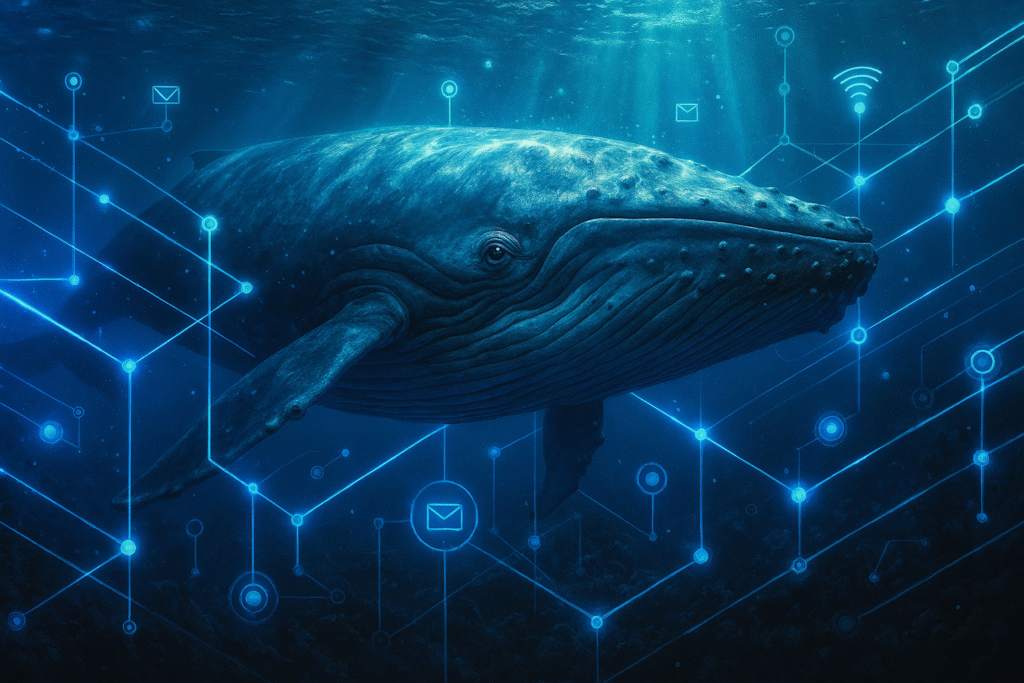
Did you know that the ocean was online before humans ever dreamed of a modem? 🌐🐚
Long before “connection” meant followers and notifications, it meant something simpler: survival. Beneath the surface, fish, whales, coral, and plankton have been sharing signals for millions of years. They trade information about food, danger, migration, and even love. And they do it with a network that never crashes—the living Internet of the sea.
🐋 The First Users: Whales, the Original Broadband Voices
Let’s start with the loudest influencers of the deep — whales. Blue whales can send low-frequency calls that travel over 500 miles through water. That’s basically a long-distance phone plan without the bill. 📞💙
Each whale species has its own “dialect.” Humpbacks sing complex songs that can last up to 30 minutes and evolve over time — kind of like a viral remix. Scientists have even observed new “chorus trends” spreading across ocean regions, the way new sounds go viral on TikTok.
When a humpback sings in the Pacific, another might pick up the melody weeks later near New Zealand. The ocean literally has trending audio. 🎶🌊
🐬 The Chatty Extroverts: Dolphins and Their Click Language
If whales are the opera singers, dolphins are the voice note addicts. 🗣️🐬
They use echolocation — clicking sounds that bounce off objects — to “see” their environment through sound. But here’s the wild part: dolphins also have names. Each dolphin develops a unique signature whistle, like a username or a handle.
When they call to each other, they mimic these signature sounds to identify friends, family, or pod members — basically saying, “Hey @FinnTheFlipper, you good?” It’s one of the most advanced communication systems in the animal kingdom, rivaling human language in structure and creativity.
And unlike most group chats, dolphins actually listen. 👂💦
🪸 The Silent Network: Coral Reefs That Signal in Color
If whales and dolphins are the voice users, coral reefs are the visual network — the Instagram of the sea. 🪸📸
Corals release chemical signals to communicate stress, attract fish, or defend territory. Some even change color when under threat, like mood rings reacting to pollution or temperature shifts.
Scientists call coral reefs the “cities of the ocean” — full of traffic, trade, and tiny conversations between species. Shrimp clean fish in exchange for food scraps; clownfish protect sea anemones in exchange for shelter. It’s all networking — literally.
The coral’s chemical signals also warn nearby reefs about bleaching events, kind of like sending a “code red” alert through the marine web. When one coral gets sick, others know it’s time to prepare.
The ocean doesn’t need email — it’s been running on instinctive alerts for millions of years.
🌌 The Invisible Data Highway: Sound and Vibration
Here’s something mind-blowing: sound travels five times faster in water than in air. That makes the ocean the most efficient means of communication on Earth.
From the deep-sea fish that flash bioluminescent patterns like Morse code to the shrimp that create massive “snap” sounds to stun prey — every layer of the ocean has its own protocol.
It’s like multiple apps running at once:
- 🐙 Octopuses use color changes and gestures.
- 🐠 Fish use motion and light patterns.
- 🦐 Crustaceans use clicks and vibrations.
Each one is tuned to its bandwidth — a perfect, natural hierarchy of communication that never overlaps or needs a restart.
Meanwhile, we humans panic when the Wi-Fi lags for 10 seconds. 😭📶
⚗️ Chemistry: The Ocean’s Secret Messaging App
Beyond sound and sight, there’s another invisible layer — chemical communication. Many marine species release pheromones or hormone-like compounds into the water to attract mates or warn of predators. These molecules diffuse through the currents, like a biological notification system.
Think of it as underwater Bluetooth — invisible but instant.
Even plankton, the microscopic drifters that make up the base of the food chain, send chemical messages to signal danger or call for allies. When predators appear, some plankton release “distress signals” that attract even bigger predators to eat the threat. That’s strategy — not survival instinct.
🧬 The Ocean Internet vs. Ours
Humans built fiber-optic cables under the sea to connect continents. But nature did it first. The biological Internet of the ocean runs on sound, light, and chemistry — and it’s self-sustaining, self-repairing, and pollution-resistant (well, until we showed up).
Our version burns energy and emits carbon. The ocean’s version creates life.
We depend on devices; the ocean depends on rhythm.
And maybe that’s the biggest difference: on the Internet, we talk endlessly but often fail to listen. In the ocean’s Internet, everything listens first. 🌊🫧
🌏 Lessons from the Deep
The ocean’s communication system teaches us something vital about balance and coexistence. Every species contributes to the network, no one dominates it, and everything — from the tiniest coral to the largest whale — matters.
If one part of the chain falls silent (for example, coral bleaching or noise pollution), the entire system begins to collapse. When ships and oil rigs fill the sea with mechanical noise, whales lose their ability to communicate. It’s like static in the group chat — dangerous silence replacing meaningful sound.
By studying these natural communication webs, scientists are even designing bio-inspired networks that could make the human Internet faster, greener, and more efficient. We’re learning from fish now — and honestly, it’s about time. 🐟💻
🪄 Final Wave
So yes, the ocean has its own Internet — ancient, alive, and beautifully complex.
It’s a reminder that connection doesn’t require wires or Wi-Fi, only awareness.
Every splash is a signal. Every ripple carries meaning. The sea has always been online — we just logged in late. 🌊✨